
Root Canal Treatment and Endodontics in Wrocław.
A toothache, deep decay or mechanical trauma does not necessarily mean extraction. Modern dentistry offers an effective solution in the form of endodontics, also known as root canal treatment. Here at MedicaDent in Wrocław, we specialise in saving teeth that would previously have been condemned to extraction.
Thanks to advanced technologies such as root canal treatment under a microscope, ultrasound, rotary instruments for root canal preparation, CBCT tomography and the CWT continuous wave method, the process is precise and safe. In many cases, it can also be completed in a single visit. Our experienced team prioritises preserving patients’ natural teeth and ensuring their complete comfort during the procedure.
Endodontics in Wrocław: what is modern treatment?
Endodontics is a field of dentistry that deals with the diagnosis and treatment of diseases of the dental pulp and periapical tissues. The pulp is a highly innervated and vascularised tissue that fills the interior of the tooth. If it becomes inflamed or infected (e.g. as a result of untreated tooth decay), rapid intervention is necessary.
Endodontic treatment at our clinic in Wrocław consists of:
- Opening the tooth chamber.
- Thorough removal of infected or dead pulp
- Mechanical and chemical preparation and widening of the root canals.
- Sealing the space with a biocompatible material (gutta-percha) that prevents the regrowth of bacteria.
This procedure preserves the tooth, providing a solid foundation for future prosthetic restoration (crown or bridge) and eliminating the need for more expensive implant treatment.
Computed tomography in endodontics
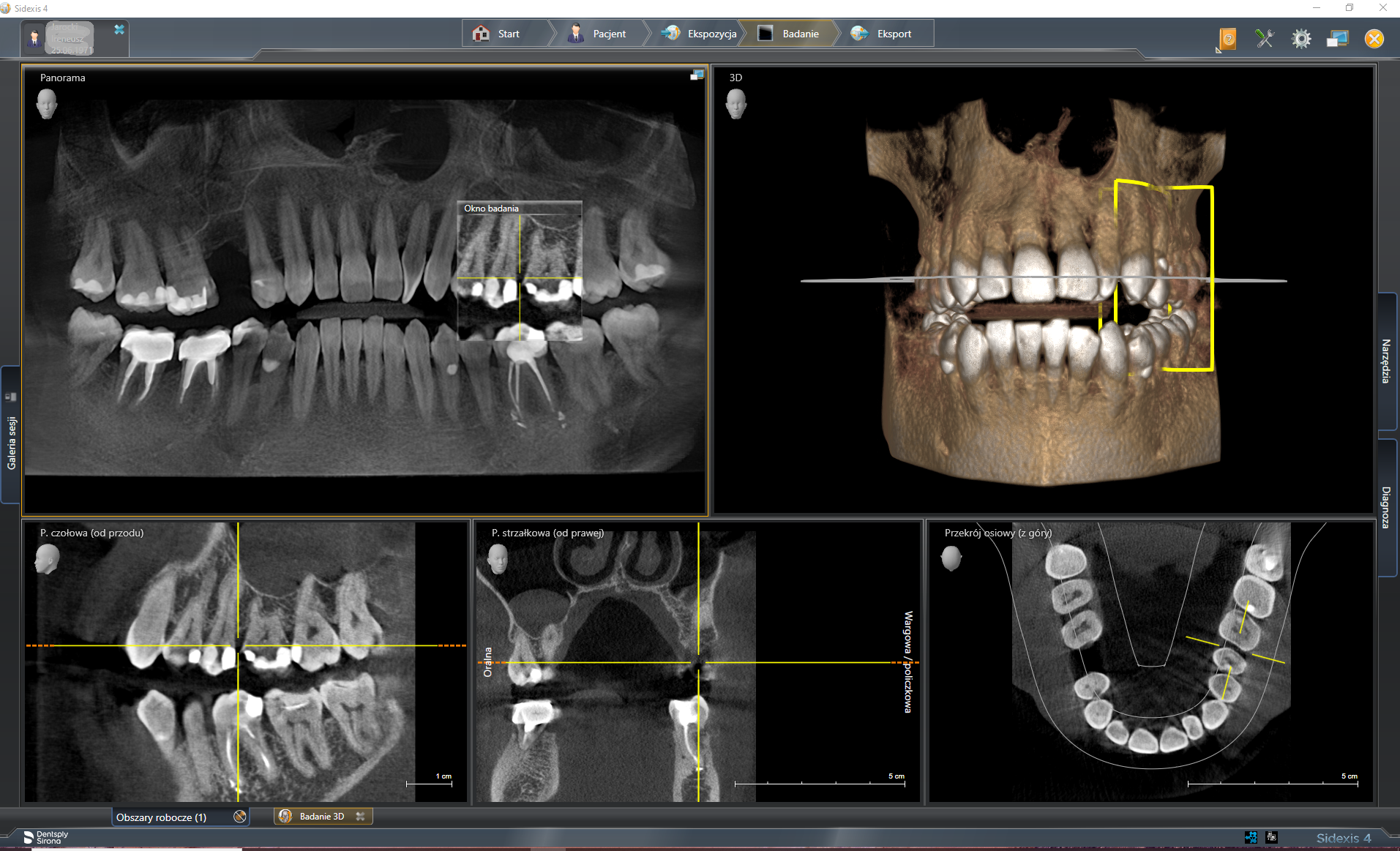
In endodontics (root canal treatment), cone beam computed tomography (CBCT) is an invaluable diagnostic tool, particularly for complex and unusual cases. Unlike traditional X-rays, which provide a two-dimensional image, CBCT provides detailed three-dimensional images of tooth structures and the surrounding tissues.
The use of tomography in endodontics:
- • Precise diagnostics: It enables an accurate evaluation of root condition, the number and course of root canals (including additional, curved or invisible ones that cannot be seen on a standard X-ray).
- Detection of inflammatory changes: It allows even small inflammatory changes (cysts and granulomas) in the bone around the root tips to be visualised, which is crucial for making a correct diagnosis.
- Retreatment (re-endo): Helps to identify the causes of previous root canal treatment failure, such as missed canals, broken instruments in the canal or perforations.
- Treatment planning: It enables the dentist to plan treatment precisely, minimising the risk of complications and increasing the likelihood of saving the tooth.
- Injury assessment: This is indispensable for assessing injuries to teeth and bones, e.g. root fractures, which are difficult to diagnose using other methods.
Indications for endodontic treatment
The decision to start treatment is made by an endodontist based on medical history and diagnostic imaging (X-ray, tomography). The most common indications include:
- Deep caries reaching the pulp of the tooth.
- Pulp necrosis or gangrene, often manifested by a change in tooth colour or severe pain.
- Mechanical injuries, such as a broken tooth crown with pulp exposure.
- Inflammation of the periapical tissues (abscesses or cysts).
- Re-endo (re-treatment of root canal): the need to correct previous errors, such as leaky root canal fillings, leaving a tool fragment in the canal, or overlooking additional canals.
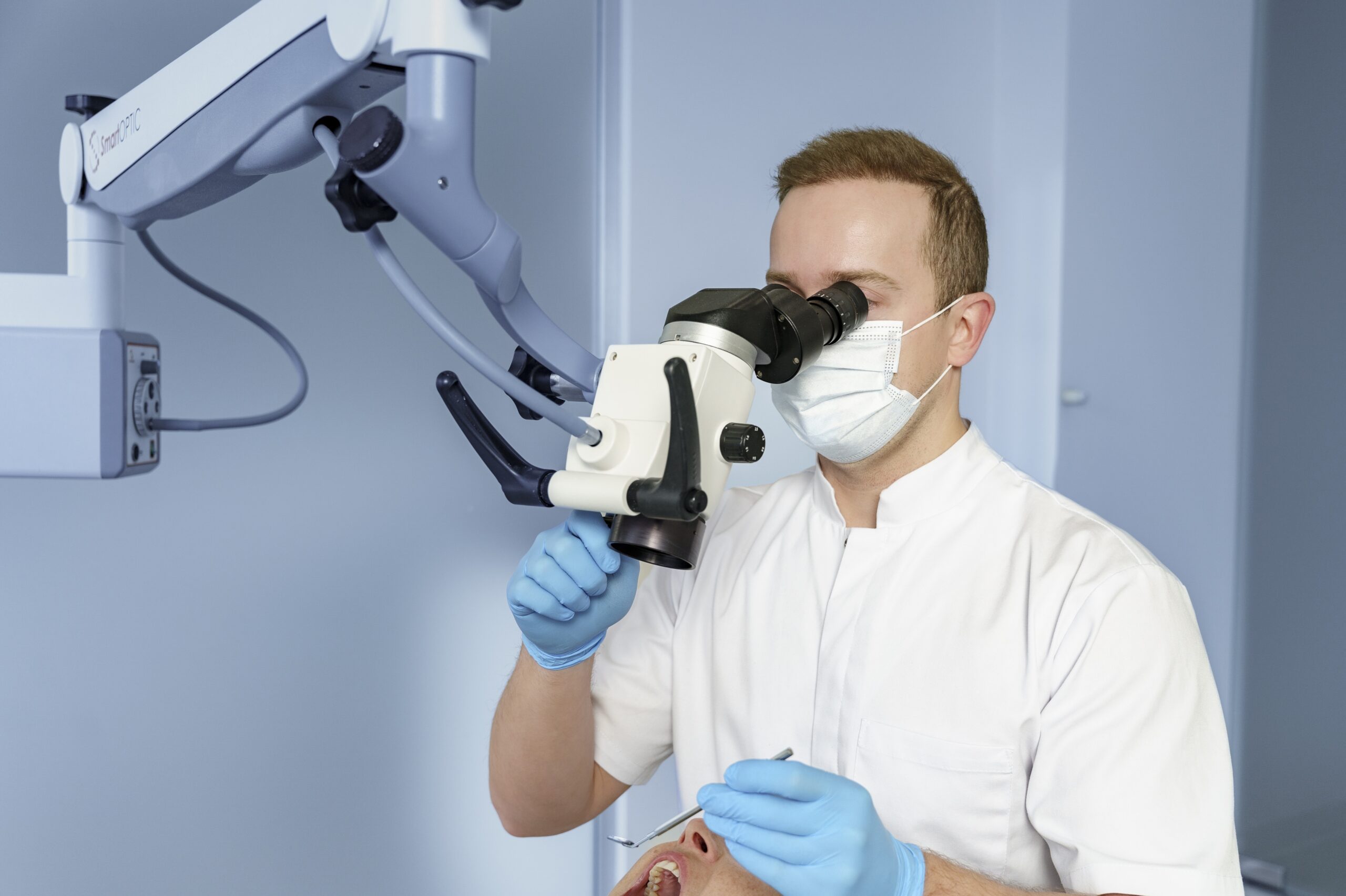
Root canal treatment under a microscope in Wrocław: precision that saves teeth.
Traditional treatment methods have often proved insufficient due to the complex anatomy of human teeth. Root canals can be curved, narrow or branched in a way that is invisible to the naked eye. The previously established ‘norm’ for the number of canals in a given tooth often differs from reality.
This is why root canal treatment under a microscope is standard practice at MedicaDent. The enlargement of the treatment field (up to 25 times) and the ideal lighting enable the dentist to:
- find all additional canals, even the thinnest ones.
- precisely treat canals with unusual shapes (e.g. curved ones).
- safely remove broken endodontic instruments left behind during previous procedures.
- detect microcracks and root perforations.
Using a microscope significantly increases the effectiveness of therapy and minimises the risk of complications such as recurrent pain or the need for tooth extraction several years later.
Endodontic surgery equipment
Effective endodontic treatment requires knowledge and specialised technological facilities. At MedicaDent, we use devices that shorten the procedure’s duration and increase its safety.
- SIRONA CBCT Tomograph: provides a detailed, three-dimensional image of tooth structures
- A surgical microscope, the heart of modern endodontics.
- Endodontic micromotor: for the precise mechanical preparation of root canals.
- Endometer (Raypex): an electronic device that accurately measures the length of the root canal, eliminating the risk of underfilling or overfilling.
- Radiovisiography (digital X-ray): enables immediate control of the course of treatment with a significantly reduced radiation dose.
- CWT method: continuous wave heat of gutta-percha.
- Endodontic scaler: helpful in activating canal rinsing agents.
Does root canal treatment hurt?
Many patients fear pain and associate root canal treatment with past traumatic experiences./ Many patients fear pain, associating root canal treatment with traumatic experiences from the past. At MedicaDent, however, we dispel these fears./ At MedicaDent, we break these stereotypes. Each procedure is preceded by the administration of effective local anaesthetic. This makes the procedure completely painless. Moreover, modern techniques often allow the treatment to be completed in a single visit, saving patients time and stress.
Root canal treatment – Frequently asked questions
How long does root canal treatment under a microscope take?
Most primary root canal treatments at our clinic are performed in a single appointment, typically/usually lasting between 60 and 90 minutes. In complex cases (e.g. re-endo, presence of purulent changes), two appointments may be necessary.
Is it worth treating a tooth with root canal treatment, or is it better to remove it?
It is always worth trying to keep your own tooth. Your own root, even after root canal treatment, is the best ‘implant’. Extraction is irreversible and requires costly prosthetic restoration, such as a bridge or an implant, to prevent bone loss, shifting of adjacent teeth, and overloading of the remaining teeth.
How does regular treatment differ from treatment under a microscope?
Microscopic endodontics enables the dentist to see the inside of the canals at high magnification, increasing precision and allowing additional canals to be found and each gap to be thoroughly cleaned.
Does your tooth need saving? Don’t delay — make an appointment today!
Book an appointment with a specialist at MedicaDent. We provide professional root canal treatment in comfortable conditions in Wrocław.